
What if Germany was punished harshly after WW2?
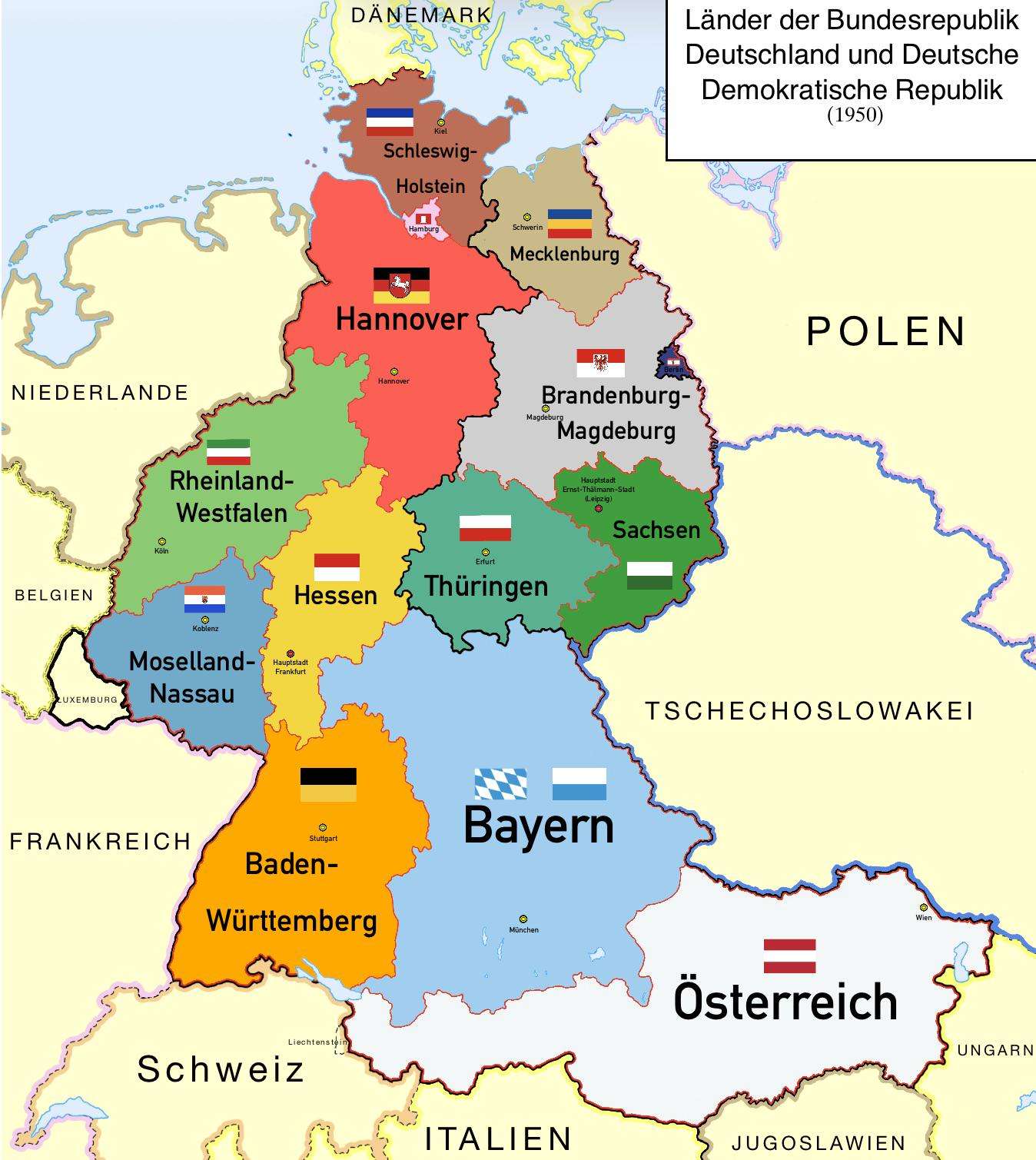
Wurstartig:
The main backstory and also some other interesting tidbits of the consequences of this reality:
Now out of sheer luck or other factors, Germany’s performance during World War II did better than in our timeline. Unfortunately for Germany, it meant being the test subject of the first atomic detonation in the city of Bremen on the 12th of August 1945. Even more unfortunately for the Allies and the U.S. specifically, this was the only one of the weapons that they had reserved for Germany, with the second of these weapons not even finished yet and to have been deployed on Japan. Consequently, Germany would still fight until the bitter end for another week before the nascent Flensburg Government would soon surrender unconditionally to the Allies. The war in the pacific would turn into a bog-fest as the U.S. and Soviet Union had no choice but to conduct an amphibious assault on the Japanese mainland in lieu of a swift surrender via atomic weaponry. Of course, the fact that Germany held out for two weeks after Bremen was essentially leveled, and the fact that a very costly offensive in the Japanese mainland had to be conducted due to their usage of this novel weapon in vain, many political analysts and sociologists would deem that the German culture was “innately warlike” and “without exception,” a notion that was much more easily adopted by both the western and eastern Allies given the massive losses concurred to the German stubbornness. Although Yalta had already took place as a conference, a secondary conference took place right after the bombing of Bremen to correct what they thought was an “incomplete” resolution drafted at the Yalta conference. With both now convinced that Germany was once more solely to blame for this ever more destructive World War II and now convinced that the German people overall had the blame and were no longer to be trusted, a much more harsher treaty plan (pictured in the post, duh) masterminded by the Soviet Foreign Affairs Minister Molotov and U.S. Secretary of the Treasury Morgenthau. A curious side note on Morhenthau’s involvement on these boundaries stems from his already infamous Morgenthau plan being corroborated to switch the execution of the “destruction of the German State” from one of reducing the German industrial capacity once to one of reducing German industrial potential forever by drastically reducing the size of the German state and respectively the German population, the German space, and the German resources. Churchill was the only person who disapproved of the plan. This reprimanding philosophy was quickly withdrawn in favor of one closely representing our own Marshall Plan and German-European reintegration , but not before intensive damage was done including one of the largest humanitarian crises in the world and of course the solidification of the German borders as shown (you’re seeing it). Whatever the response of the German people were and the attitudes they now hold on the world and themselves, it is up to you to decide (but feel free to ask if you’re bored), but the German officials, government, and history would still follow a similar path to our own timeline, save for a shadowy lingering bitter resentment and taboo grief that was just always there and continued to be in this timeline indefinitely.
Now to the details & other random thoughts:
The Eastern borders of Germany followed a similar pattern to our own timeline with the swift and unforgiving removal of the people living there. Indeed, Poland had lost a fourth of Silesia to Czechoslovakia in post-war agreements as well as Bialystock to the Soviets which wanted to nurture competitive distrust within the Eastern Bloc to divert their attention away from themselves. Now you may notice a weird exclave near what’s Rostock. This is because after the war, the Soviets provided very limited assistance in actually enforcing the new borders and though most families were compliant to the Polish authority in charge of doing so, the exclaves present an exception to this as a band of hardy farmers and foresters took up arms to defend their homes, providing very heavy resistance that failed to get rooted out by the Polish army. The Polish Air Force was at the time very weak and pilots were unwilling to embark on a mission to subdue to area due to the forested terrain in the exclaves. The army, though laid siege on the exclaves for a good 8 months after the end of the war in Europe, eventually was forced to back down by the Soviet Union in response to the concerned reaction the western Allies had to this violent breakdown. The farmers thus achieved their purpose of retaining their land, and after another 6 months of being in a weird limbo, they were eventually reincorporated to the authority overseeing the East German reincorporation. Speaking of which, the eastern boundaries given to Poland were unforgiving in this timeline, including ceding the ruins of East Berlin to Poland itself (though a smaller portion with the boundary starting east of Alexanderplatz) . By the time the western allies realized that this was a huge mistake, it was of course too late, though it did not stop both sides from flourishing after the war was over. When it comes down to Czechoslovakia, they were compensated extremely generously including a new southern border at the Danube river. The reason that Austria was, by the way, incorporated into Germany proper was because the Soviets, suspecting a neutral Austria would only be used as a back door for meddling Western operations into the Eastern Bloc, decided to carve it up between Czechoslovakia and Yugoslavia on the condition that West Vienna was ceded to the allies, which gave it to Germany given its weakened state and due to its newfound western alignment. The territories given to Czechoslovakia would see a similar fate to those of Poland or the Sudentenland, with the exception of Vienna, which was protected from any sort of displacement that the other territories saw. Instead, East Vienna was given a special status within Czechoslovakia giving them autonomy enforced (and overseen) by the Soviet Union. After reunification in the 1990s, East Vienna would have been reunified with its western part and thus welcomed into the Federal Republic of Germany under Austria. Lastly, the Dutch also had significant territorial concessions given to them as they had demanded them. Unlike the eastern border realignments, this did not result in the complete expulsion of all Germans, though it was by no means forgiving either. Rather, the demographics would look like a gradient with nearly all of the locals being removed to some German villages remaining untouched as you go from west to east of the pre-war borders. Dutch farmers and homesteaders would get priority to the land as requested, interestingly resulting in the abortion of all future land reclamation projects as there was no longer any need for them as well as the creation of the most expansive highway system paralleling the modern U.S. infrastructural system to accommodate the new swaths of land that the Dutch government received. For all Germans remaining in the territory, they were allowed to assimilate with the condition of adopting the Dutch language as the official language of use and commerce in their territories.
Now a brief explanation on the two Germanies themselves. West Germany decided to host their capital in Frankfurt given historical importance as the capital of the eastern Carolinian empire. Though the East German government initially created and upheld new [Länder], the system was replaced with districts to support a more centralized government, though they were reinstated once more after reunification in 1990 with minimal modifications.
If you have any further questions for this timeline in any regard, feel free to ask!
Collection: alternate-history - Tags: alternate-history, germany - Source: reddit.com