

Western Amazon basin 12 million years ago
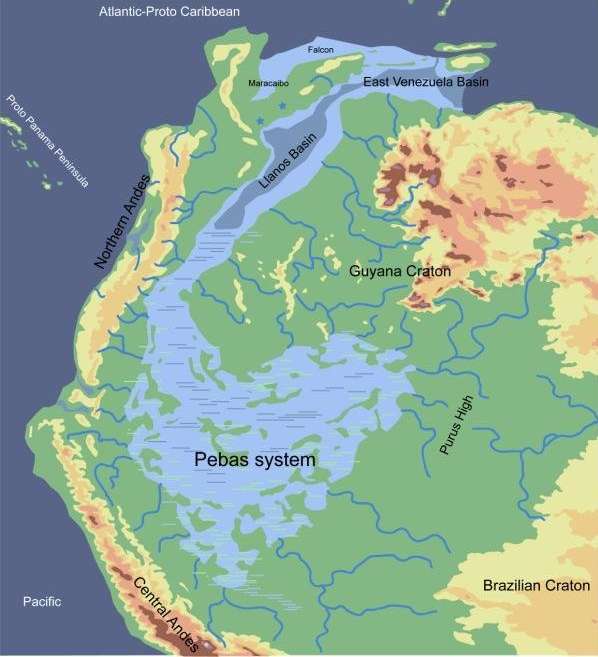
Western Amazon basin 12 million years ago—home of Purussaurus, one of the largest crocodilians ever discovered
The Western Amazon basin has intermittently been an inland sea, a giant freshwater lake, and a network of seemingly endless swamps.
Purussaurus was a giant caiman that inhabited these environments during the Miocene, rivaling the size of the largest Cretaceous crocodilians.
Its extinction coincides with drastic changes that reshaped the Amazon basin. As Los Llanos filled in to become the seasonally flooded savanna we know of today, a megalake formed which drained through the eastern hills. The river eroded through the hills, and at the same time the rising Andes mountains filled the basin with sediment, until the megalake/megaswamp filled in and dried out to became the seasonally flooded forest of the modern Western Amazon. This is part of the reason the Western Amazon doesn’t have soils quite as poor as most rainforest soils, and biological productivity is exceptionally high.
Today, one of the largest crocodilians in the western hemisphere—the Black Caiman—shares the main branch of the Amazon River with many smaller species of Caiman. But it would be dwarfed in size by its predecessors.
Collection: earth-history - Tags: earth-history, amazonia - Source: researchgate.net