

Colonization of North America
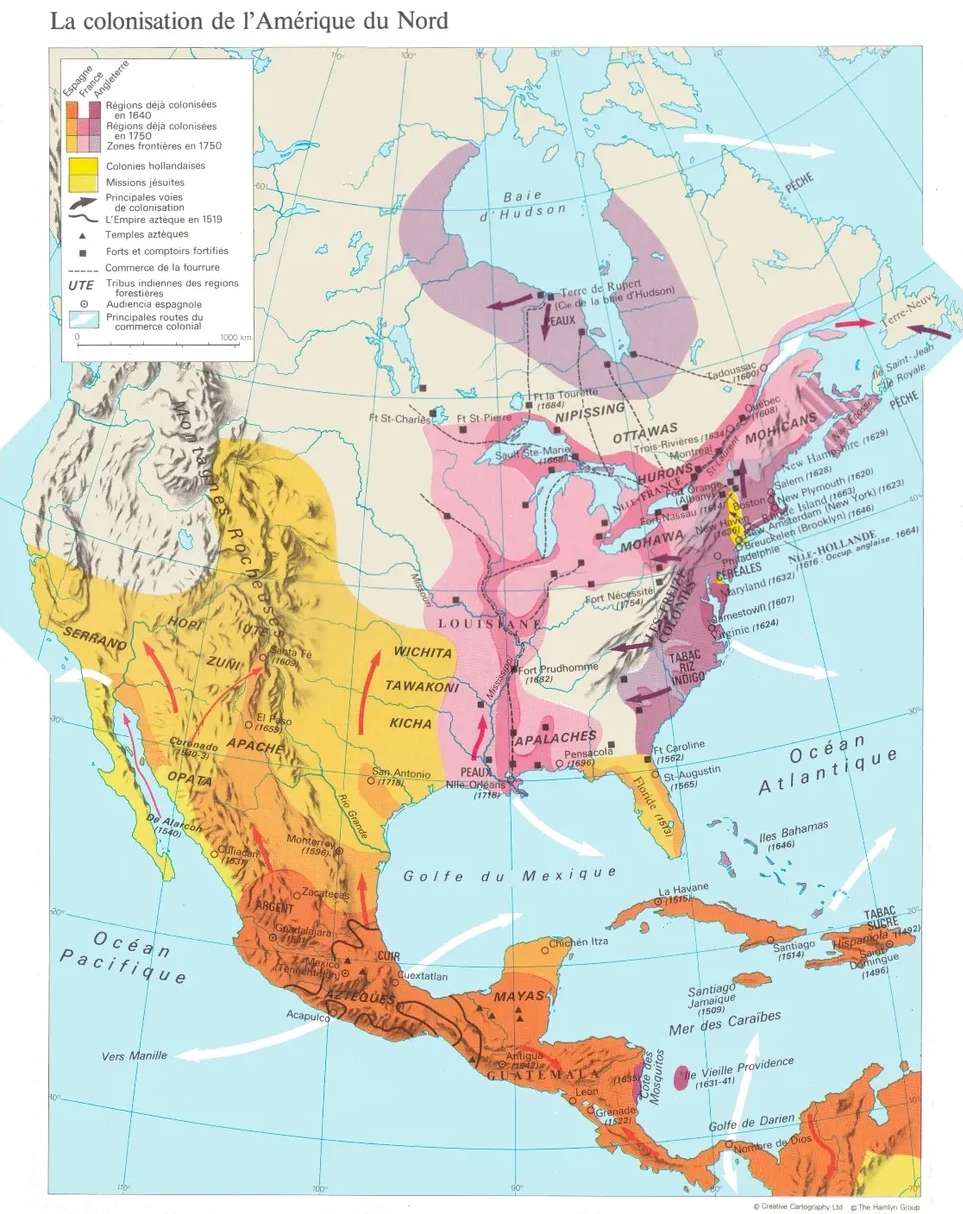
« Atlas historique » Nathan, 1982
Colonization of North America began later than South America and was the result of a greater number of powers.
The Antilles, in particular, were at the heart of intense competition between colonizing states: England was the main beneficiary and Spain, colonizing from its very beginning, was the main loser. In the Antillean Sea, Dutch, English and French pirates plundered Spanish ships from Curaçao (which became Dutch in 1634), Jamaica (English from 1655) and Santo Domingo (French from 1665). However, these territorial losses were minimal and the Spanish remained masters of traffic, including in the Pacific, until the end of the 18th century.
In the 18th century, all the English colonies in North America were not worth, together, a dozen sugar-producing islands. The West Indies provided more British imports and exports, both in value and quantity as all the North American colonies.
It took several centuries for Europe to absorb the discoveries of the early 16th century. It was only in 1600 that the flora and fauna of the New World were adequately described, and it took even longer for American foods (potatoes, corn, vanilla, cocoa, squash, tomato, pepper) to modify the diet of Europeans, which they did nonetheless in 1600. deep, and worldwide.
It wasn't only in the 17th century that the French, Dutch, and English developed commercial and colonial empires alongside the Portuguese and the Spanish, and it wasn't only after 1700 that North America and Brazil were actually colonized.
Once Europe assimilated the input of the New World, it was able to repeat the same process, in Siberia, India, Australia and on the margins of America.
Collection: world-history - Tags: colonization, north-america, history, 17th-century - Source: instagram.com