

Colonization of South America
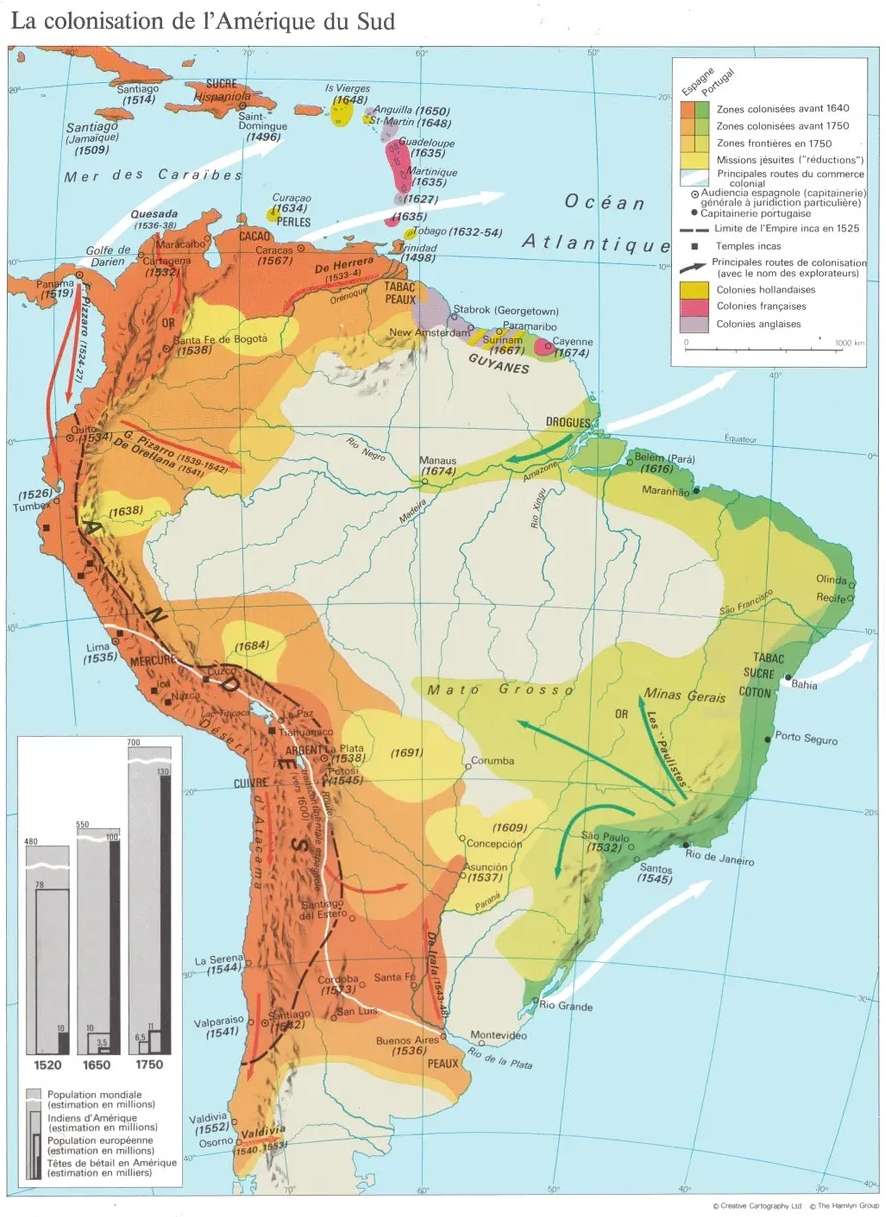
« Atlas historique » Nathan, 1982
The first European colonial empire was the Spanish Empire (it should be noted, however, that the word "colony" has only been used from the 18th century. ). In 1600 it was largest, most populated and most prosperous. Theoretically, Spain claims sovereignty over all America west of a line agreed during the Treaty of Tordesillas in 1494.
Wealth is concentrated in the fertile areas of Central and South America, where herd rearing and logging provide for the colonies' basic necessities. Except for a few Jesuit settlements, the population is scarce in northern Mexico and eastern Peru.
The only industry is silver mines that requires big initial investment. Neither in the hacienda, nor in the mine, Indians are not considered slaves: A theological debate has concluded that American Indians are not slaves in the Aristotelian sense - but African blacks are. The cost of operating the mine and transporting money exceeds the amount of profit, so that the volume of money produced peaked only after 1580, to fall to its lowest figure in less than a century in 1650. At the same time, the colonies import less products from Europe, because they have become autarcic.
From 1580 to 1640, Portugal is politically united with Spain and this association makes it lose much more than it brings. After 1640, the Portuguese reclaimed their territories and, in the captains of Bahia and Pernambouc, they planted sugarcane widely. Northern Europe lacks sugar: in the 17th century, Brazilian plantations, equipped with elaborate mechanical equipment, supplied Europe to the point of making sugar a common consumer product and it became the main transocean cargo. To run the mills and cut the cane, labor is servile: sugar and slavery have been closely associated from the beginning.
Collection: world-history - Tags: colonization, south-america, history, 17th-century - Source: instagram.com