

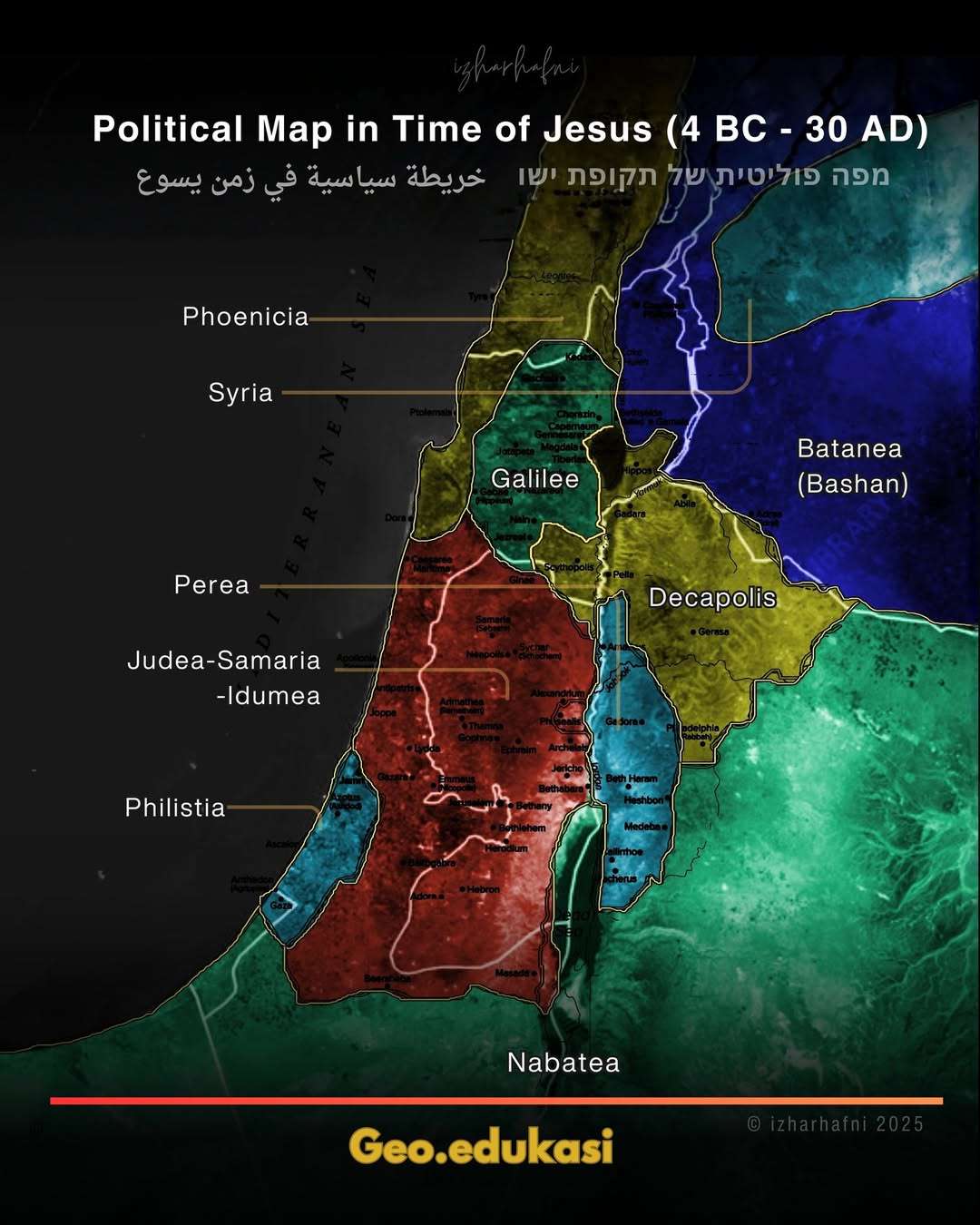
Political map of current day Israel/Palestine in time of Jesus
author: geo.edukasi/instagram, added on: 2026-01-25
geo.edukasi:
During the period spanning 4 BC to 30 AD, the Mediterranean world was defined by the absolute hegemony of the Roman Empire. At the time of Jesus' birth, Augustus Caesar served as the first Roman Emperor, establishing the Pax Romana, a period of relative internal peace and administrative consolidation. By the time of Jesus' public ministry and death, Tiberius had succeeded him. In this era, the Levant was not a single political unit but a collection of territories overseen by the Roman province of Syria. The Roman strategy relied on a combination of direct rule and the use of client kings who were tasked with maintaining order and ensuring the flow of tax revenue to Rome, effectively making the region a strategic buffer zone between the empire and its eastern rivals.
The internal political map changed drastically following the death of Herod the Great in 4 BC. His kingdom, which had been unified under his rule, was partitioned among his sons in an arrangement known as the Herodian Tetrarchy. Herod Archelaus received the heartland of Judea, Samaria, and Idumea, but his rule was so unstable that Rome deposed him in 6 AD, replacing him with a series of Roman prefects, including Pontius Pilate. Meanwhile, Herod Antipas governed Galilee and Perea as a tetrarch throughout the entirety of Jesus' life. A third brother, Philip, ruled the northern territories of Iturea and Trachonitis. This meant that a journey from Galilee to Jerusalem involved moving between different political jurisdictions, from a client kingdom to a territory under direct Roman military administration.
Beyond the immediate Jewish territories, the political map was a mosaic of diverse cultural and sovereign entities. To the east of the Jordan River lay the Decapolis, a confederation of ten independent Hellenistic city-states that served as centers of Greek culture, language, and trade within the region. To the south and southeast was the Nabataean Kingdom, an independent Arab power with its capital at Petra, which controlled vital trade routes and occasionally engaged in border conflicts with the Herodian rulers.
Collection: world-history - Tags: history, israel, palestine, 1st-century - Source: instagram.com